

What Does a Renovation Cost by Project Type in the Twin Cities?
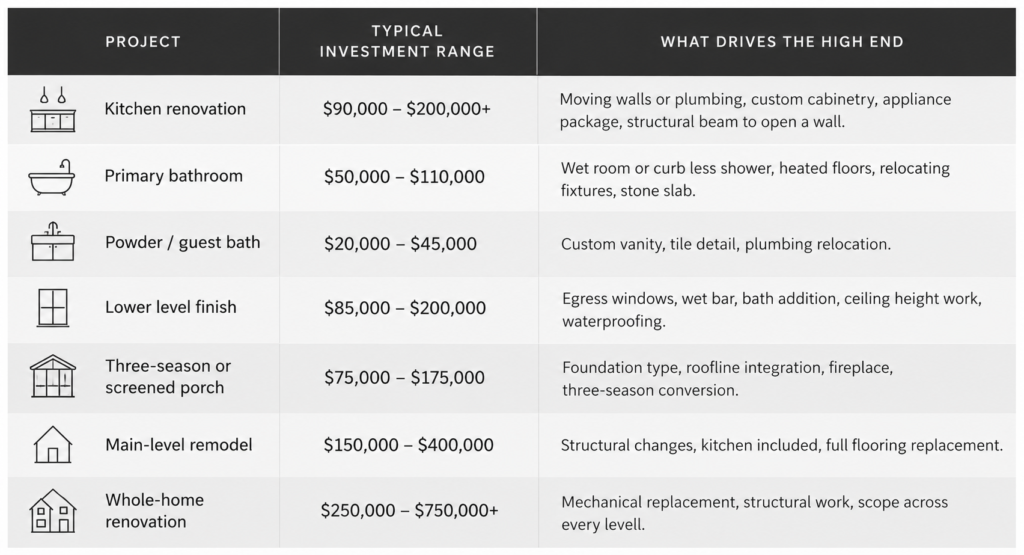
Quick answer: In the Twin Cities, a full-service design-build renovation typically runs $90,000 – $250,000 for a kitchen, $50,000 – $110,000 for a primary bathroom, $85,000–$200,000 for a finished lower level, and $250,000 and up for a whole-home renovation. The final number depends far more on scope, structural work, and finish level than on square footage alone. Below is how renovation pricing actually works in the Twin Cities market, what moves the number, and how to build a budget you can trust before you fall in love with a design you can’t fund.
Here are the investment ranges we typically see for full-service design-build renovations across the metro, including design, permits, materials, labor, and project management.
Why Do Renovation Estimates Vary So Much Between Contractors?
Estimates vary because contractors include different scopes at different levels of detail. A low bid usually reflects an incomplete scope, allowances set artificially low or excluded work that reappears later as a change order.
When comparing proposals, look for these five things:
- Allowances vs. selections: A $15,000 cabinet allowance and a $60,000 cabinet allowance produce wildly different bids for identical drawings. Compare allowance lines, not bottom lines.
- Is design included? Some numbers exclude architectural and interior design entirely.
- Permits and inspections. Should be a named line item, not an assumption.
- Structural and mechanical contingency. Older homes routinely reveal knob-and-tube wiring, undersized service panels, or a load-bearing wall where the plans showed none.
- Who manages the trades. A design-build firm like Custom One Renovation carries that cost internally. A low bidder may be expecting you to coordinate it.
What Percentage Should I Budget for Contingency?
Budget 10–15% contingency for a newer home and 15–20% for a home built before 1970. Older Twin Cities homes may hide more surprises, and those surprises are usually mechanical, structural, or code-related.
Contingency is not padding. It is the difference between a discovery becoming a decision and a discovery becoming a crisis. Common contingency triggers in this market:
- Electrical service upgrades to support a modern kitchen load
- Asbestos or lead paint abatement in pre-1978 homes
- Undersized floor joists discovered when flooring comes up
- Ductwork rerouting when a ceiling is opened
- Foundation or drainage remediation in lower-level projects
Which Renovations Hold Their Value Best in Minnesota?
In the Twin Cities, kitchens, primary bathrooms, kitchens and finished lower levels with an added bathroom consistently deliver the strongest combination of daily livability and resale support. Exterior work including siding, roofing, windows – protects value rather than adding it, but a failed exterior actively destroys it.
A useful way to think about it: renovations fall into three buckets.
- Livability investments. Kitchens, primary suites, mudrooms, porches. You buy these for the ten years you’ll live there.
- Capacity investments. Additions, lower levels, above-garage suites. These change what your home can hold — multigenerational living, a real home office, teenagers who need their own space.
- Protective investments. Roof, siding, windows, drainage. These don’t show up in a listing photo, but deferred maintenance shows up in an inspection report.
When Should I Start Planning to Renovate?
Start conversations 6–9 months before you want construction to begin. Design, selections, engineering, and permitting take time before the first demolition day.
FAQ - Renovation and Remodeling for Twin Cities Homes
We develop pricing through a collaborative design process so the number you approve reflects your actual selections and the actual condition of your home – not a placeholder. That’s the point of design-build: pricing tightens as decisions get made, instead of surprising you after demolition.
Not separately in most cases. A design-build firm carries design, engineering, and construction under one contract, which is why scope gaps and finger-pointing between designer and builder largely disappear.
Yes, in nearly all cases where plumbing, electrical, or structure is altered. Requirements vary by municipality — Edina, Minneapolis, Woodbury, and Wayzata each administer their own review.
Usually yes for a single-room project, and usually not for a whole-home renovation. Kitchens are the hard case – plan for 10–16 weeks with a temporary kitchen setup.
Ready to Put a Real Number on Your Project?
Whether you’re considering a kitchen remodel, whole-home renovation, outdoor living project, or exterior transformation, Custom One Renovations would love to help bring your vision to life.
EXPLORE MORE WITH CUSTOM ONE RENOVATION
